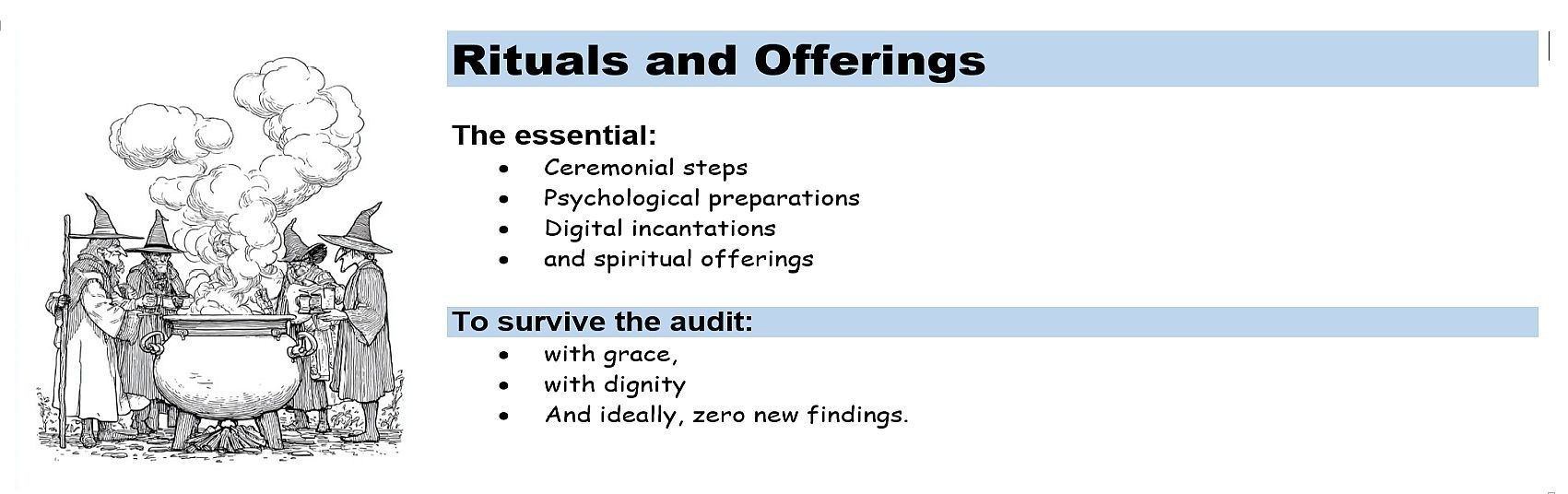


from Fear-Driven Compliance: A Practical Guide for Auditors and the Audited™
Introduction
The annual audit is less a process and more a seasonal migration of anxiety. Like tax season, hurricane season, or “Why is the CEO asking about MongoDB?” season, it arrives every year whether anyone is ready or not.
This chapter lays out the essential ceremonial steps, psychological preparations, and spiritual offerings required to survive the audit with grace, dignity, and ideally zero new findings.
The Audit Pre-Season Rituals
Audit readiness begins months before the auditors arrive, in a period known as The Quiet Panic.
The Cleansing of the Shared Drive
This involves removing files named:
- “finalfinalreally_final.xlsx”
- “approved-ish.docx”
- “notesfromsteve(ignorethese).txt”
- “deletebeforeaudit.pptx”
After deleting them, recreate only two folders:
- Controls
- Controls (Archived)
Everything auditors need should be in one of these. They do not need to know which one.
The Offerings
Each audit season requires a symbolic offering to appease the auditors. Traditional offerings include:
- A fresh stack of binders
- A bowl of individually wrapped mints
- A room with slightly uncomfortable chairs
- Printing the org chart on exorbitantly expensive paper
The goal is to create the impression of hospitality without providing actual comfort.
Figure 10-1
A conference table with binders arranged in a pattern suggesting either compliance or summoning.
The Ritual Phrases
Certain phrases must be memorized and recited during the audit to maintain defensive posture:
- “Let me take that back for validation.”
- “That process is currently being optimized.”
- “We’re aligning on a revised ownership model.”
- “Great catch — we were just discussing that last week.”
- “Yes, we have documentation.” (Do not specify where.)
These phrases signal maturity while revealing nothing.
The Alignment Ceremony
Before auditors arrive, gather your team for a short but impactful ritual known as:
The Alignment Ceremony (also called The Sync, The Huddle, or The Oh No It’s Today).
Participants must agree on:
- How many systems you actually have
- Which version of the org chart is in use
- What to call the legacy system no one touches
- Whether a process is “annual,” “quarterly,” or “semi-ad-hoc”
End with an oath:
“We will speak as one system.”
Preparing the Audit Room
The audit room must project three core qualities:
- Stability
- Seriousness
- An almost unsettling abundance of office supplies
Required Items
- A monitor that only displays dashboards
- Pens that do not work
- A whiteboard full of diagrams no one understands
- A calendar permanently on the current month
- A strategically placed potted plant for emotional buffering
The Great Documentation Harvest
In this phase you gather:
- Every policy you’ve ever drafted
- Every piece of documentation that looks like policy
- Every email that feels like policy
Create one massive PDF named:
“EnterpriseControlsMastervFinal_1.0.pdf”
Regardless of content, the file name alone suggests excellence.
Pre-Audit Meditation
On the day before auditors arrive, practice grounding exercises:
Exercise:
Sit comfortably. Breathe deeply. Repeat the mantra:
“They can’t ask what doesn’t exist.”
If interrupted, say you’re “conducting risk assessment alignment.”
Footnotes
- The Shared Drive Cleansing may reveal artifacts from predecessors. Treat these with caution.
- If the auditors request comfort, offer compliance metrics instead.
- Plants in the audit room must be real; auditors can detect fake foliage.
Summary
Preparing for the annual audit is a dance of perception, preparedness, and controlled ambiguity. With the proper rituals and offerings, you too can create an environment in which the auditors sense order, you maintain composure, and the legacy PICK system hums quietly in the background, untouched and definitely untested.
Next article:
The computer room was flooded after the fire
Next Step:
🗓️ Schedule a discovery call
Talk about issues and opportunities for your current system before you commit.