

Introduction: A Realistic Worst Case Scenario
Every audit begins with a story. Sadly, very few are uplifting.
Some organizations open their audit season with a successful system upgrade, the rollout of a new policy, or a miraculous discovery that someone actually documented a process back in 2019.
Your organization, however, begins with:
- a fire in the computer room,
- followed by a flood (because why have one disaster when you can have two?),
- and your only IT technician — Don — contracting pneumonia so severe he still cannot remember the root password.
As opening chapters go, this one writes itself.
The auditors have arrived. You have… concerns.
The Disaster Matryoshka
Auditors are used to hearing excuses.
They have seen:
- systems go offline,
- backups fail,
- and entire departments vanish mysteriously during “restructuring.”
But nothing compares to The Disaster Matryoshka — a catastrophe nested inside another catastrophe, wrapped in a medical emergency.
Your story has three layers:
- Fire — The initial event.
- Flood — The sequel nobody asked for.
- Don’s Hospitalization — The twist ending that makes auditors pause and re-evaluate their life choices.
This narrative is so overwhelming that auditors often stop taking notes and simply stare.
This is good. Use this moment of stunned silence to your advantage.
Don, the Former Keeper of All Knowledge
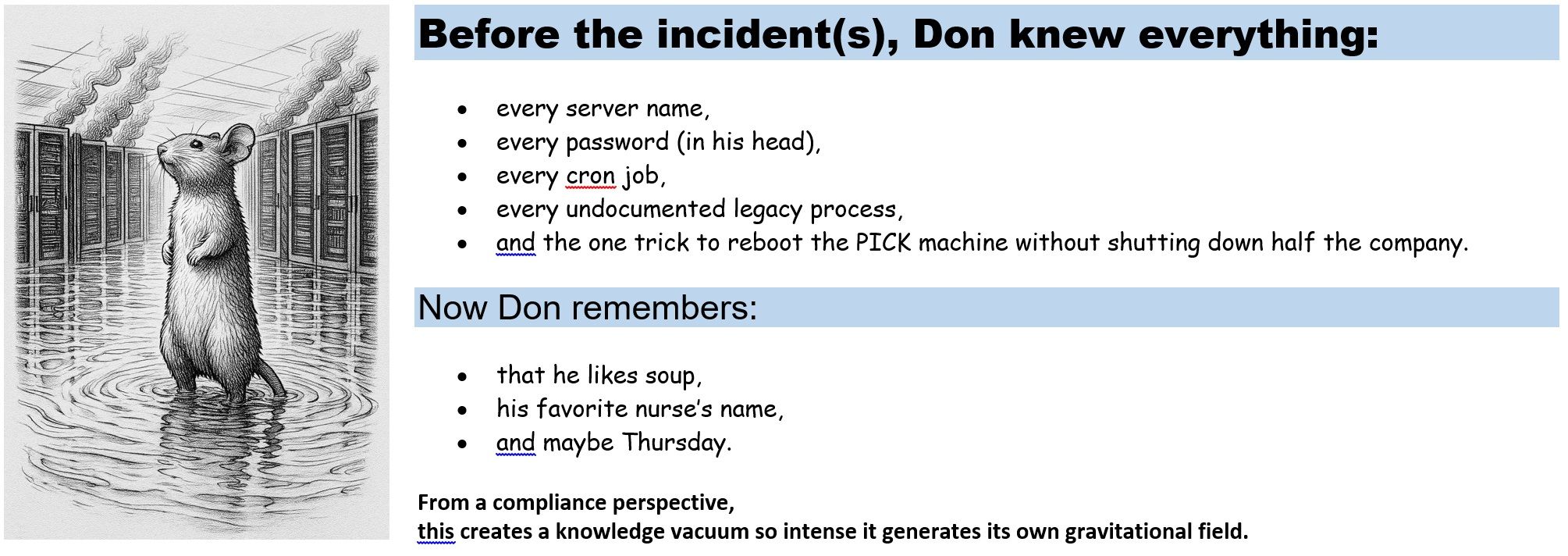
Before the incident(s), Don knew everything:
- every server name,
- every password (in his head),
- every cron job,
- every undocumented legacy process,
- and the one trick to reboot the PICK machine without shutting down half the company.
Now Don remembers:
- that he likes soup,
- his favorite nurse’s name,
- and maybe Thursday.
From a compliance perspective, this creates a knowledge vacuum so intense it generates its own gravitational field.
Auditors call this “Single Point of Failure Risk.” You call it “Tuesday.”
The Computer Room Incident Report
The facts, as presented to auditors, look something like this:
- Fire starts in the computer room
- Cause: still under investigation, possibly related to “the extension cord situation.”
- Sprinklers activate, drenching every server containing production data
This is known as “horizontal cooling” in disaster recovery terminology.
- Water damage spreads through racks, cables, and the box labeled “BACKUPS — DO NOT TOUCH” This is ironic.
- The floor buckles, likely due to thermal fluctuations, structural fatigue, and the tragic curse placed on your infrastructure in 1998
- IT technician Don, in an act of heroism / poor decision-making, rushes into the smoky room Outcome: pneumonia, hospitalization, memory loss, and zero recollection of the root password.
Auditors will ask why the backups weren’t offsite. You will respond with:
“They were offsite. The fire was onsite. The flood, however, was… everywhere.”
How This Impacts the Audit (Spoiler: A Lot)
From the auditors’ viewpoint, this combination of events affects every major control:
Access Control
Don used to approve everything.
Now Don cannot remember his Wi-Fi password.
Change Management
All changes went through Don.
All changes are now “pending Don’s recovery.”
Backup Integrity
Backups were stored “next to the servers” because someone once said,
“Keep your friends close and your backups closer.”
Business Continuity Plan
Last updated: never.
Disaster Recovery Plan
A printout from 2003 referencing equipment you no longer own.
Your New Audit Strategy: Lean In
When auditors ask for documentation, simply hand them:
- a photograph of the burnt server rack,
- a mop,
- and Don’s doctor’s note.
Then say:
“We expect your full cooperation during this difficult time.”
Auditors are human.
Mostly.
This appeals to the part of them that remembers empathy.
Summary
The computer room burned. The sprinklers flooded the remains. Your only IT technician was hospitalized and now cannot recall what RAID stands for.
And yet — somehow — the organization must endure its audit.
This Chapter sets the stage for a simple truth:
Audit readiness is less about perfect controls and more about perfect storytelling.
And this story? This one may be unforgettable.
Next chapter:
Your last Pick Programmer just gave notice
Next Step:
🗓️ Schedule a discovery call
Talk about issues and opportunities for your current system before you commit.