


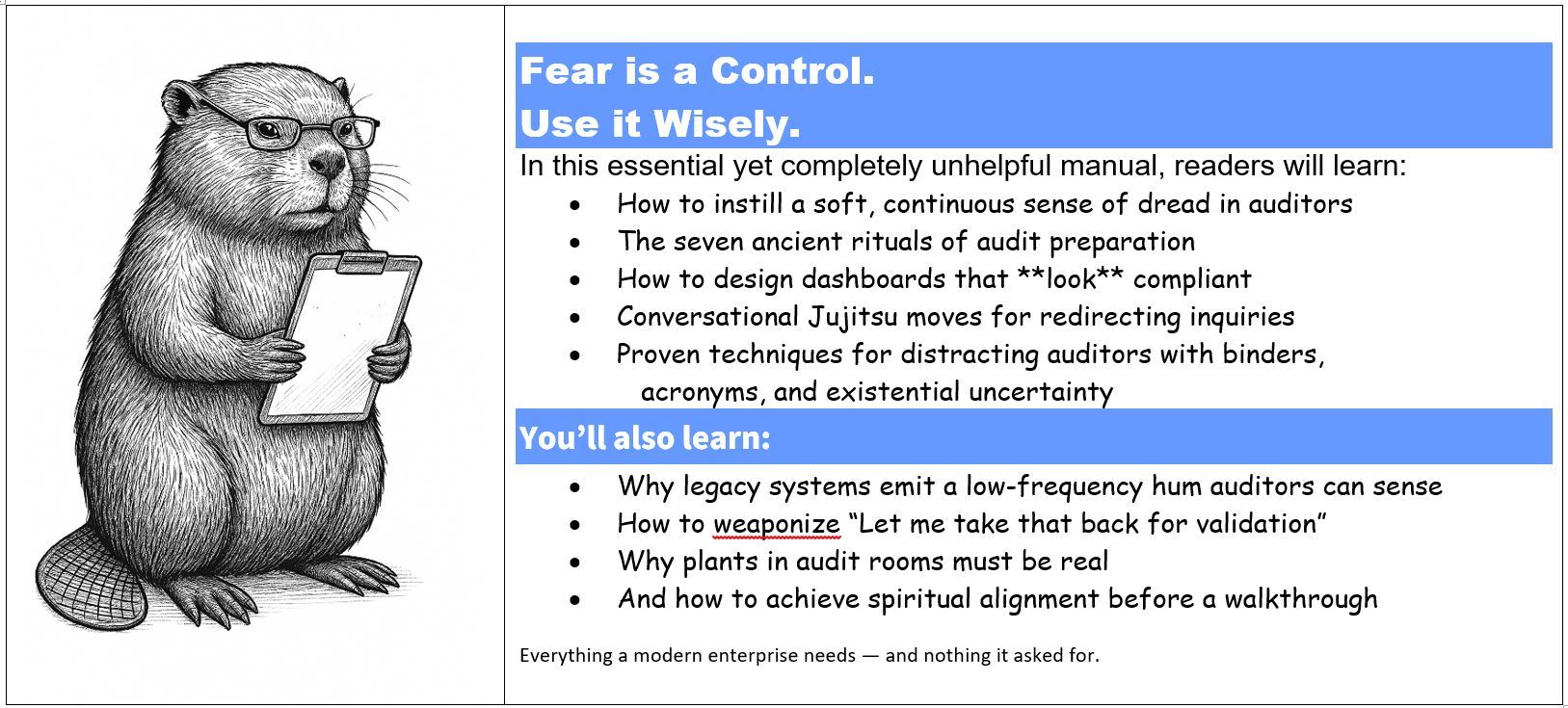


Introduction
Auditors, as a profession, are genetically predisposed to detect anomalies. Your goal is not to hide anomalies—this violates several laws and at least one cosmic principle—but to produce just enough ambient mystery that auditors reconsider their life choices.
This chapter offers tested, enterprise-ready strategies for creating a healthy fear response in auditors while maintaining full compliance, plausible deniability, and the appearance of strong internal controls.
Understanding the Auditor Mindset
Auditors are governed by three instincts:

Follow the evidence trail
Ask who approved things
Fear anything undocumented
By subtly manipulating these instincts, you can create an atmosphere of uncertainty that is both safe and enjoyable.
Strategy 1: Deploying the Mysterious Binders

Pro Tip: The binders need not contain anything. The power is purely psychological.
Place two thick, unlabeled binders on the meeting table before the auditors arrive.
When they finally ask, “What’s in the binders?” respond only with:
“We’ll get to that… if we have time.”
Then never mention it again.
Strategy 2: Schrödinger’s Control Environment

If asked whether a control exists, reply:
“Well, that depends on your testing approach.”
This introduces the terrifying notion that your controls might obey quantum superposition.
If they request documentation, hand them a folder containing a single Post-it note that reads: “Control Approved (Probabilistically).”
Strategy 3: Weaponized Transparency™
Weaponized Transparency is the art of providing more information than any human auditor could possibly want.
For example, when asked how you validate vendor invoices, say:
“I’m glad you asked! It all started in 1974 when George wrote our original PICK enterprise application, which—interestingly—was accidentally powered off during a hurricane…”
Show them a 48-slide deck titled Invoice Validation: A Hero’s Journey.
... with chapters on "GFE Repair", "Unable to find Boot Sector", Security Work-arounds, Overnight process aborts, Failure log corruption, System Restores from off-site storage, and a final slide titled, "%%%%%%% Parity Error"
The fear here is not of non-compliance, but of your unlimited capacity to keep talking.
Strategy 4: The Legacy System Reveal

Every organization has at least one ancient system quietly existing in a corner of the infrastructure.
At the appropriate moment, lower your voice and say:
“We still have one program running on hardware older than the auditors themselves.” “We don’t touch it anymore. It… touches itself.”
Then stare into the middle distance.
Strategy 5: The Decimal Point Shuffle
Auditors fear numbers. They fear numbers that might be wrong even more.
When asked for revenue totals, provide three versions:
- $3,948,230.47
- $3,948,230.471
- $3,948,203.74
Say confidently:
“Depending on which rounding standard you endorse, one of these is correct.”
Then add, ominously:
“ASC(251) can be… unpredictable.”
Strategy 6: Silent Logging

Whenever an auditor enters the room, type something into an invisible terminal window and whisper:
“Incident logged.”
Press Enter with drama. Do not explain the logging system.
Let them imagine it.
Strategy 7: The Ownership Paradox

When asked who owns a particular process, hand them three org charts from different decades.
If pressed, respond:
“Process ownership is tribal. We don’t assign ownership; we discover it.”
Auditors hate anthropology.
Practical Demonstration Script
Below is a role-play script for training staff on Auditor Fear Inducement:

Auditor: “Can we see your change-management documentation?”
You: “Absolutely. Which century would you like?”
Auditor: “The current one.”
You: “Ah. That narrows it down.
Somewhat.”
Only in Jamaica
When asked to see the physical storage for the Rental Agreements, respond by leading the auditors along a seriously water stained carpet leading to a stout door labelled 'Secure Storage".
Opening the door, a beam of light pierces the darkness from within, through a large hole in the ceiling.

As their eyes adjust to the light, rows and rows of water logged and weather beaten cardboard boxes become visible.
Peeking in to a box labelled "Rental Agreements", the senior auditor steps back, gags and weakly squeaks, "they are all stuck together"
Tell them that during rainy season, "some of the invoices got wet".
Usually by this time, the senior auditor will have run through the Casa Montego Arcade, climbed the coral wall and let out a long, loud primal scream.
The fruit lady smiled and said in a stage whisper. "This must be your first trip to Jamaica."
This always works.
Only the fools survive.
Summary
Instilling fear in auditors is not about deception—it’s about vibes. By combining uncertainty, irreducible complexity, and just a hint of metaphysics, you can create the perfect audit environment: one in which you feel prepared, and they feel slightly uneasy.
Footnotes
- Do not actually attempt to confuse the auditors using quantum metaphors unless you are prepared for follow-up questions.
- Weaponized Transparency™ is not currently recognized by the SEC, though enthusiasm is growing.
- The legacy system referenced in §7.5 is fictional. Probably.
- Auditors are not actually raccoons, though both species exhibit an instinctual attraction to shiny objects labeled “evidence.”
- The “Mysterious Binder” technique is banned in three states and one strict HOA.
- Quantum controls are not recognized by the PCAOB, though physicists remain optimistic.
from Fear-Driven Compliance: A Practical Guide for Auditors and the Audited™
We hope you like this tongue in cheek bit of brevity. Wouldn't it have been fun to be there?
Next Chapter:
Conversational Jujitsu for Audit Meetings
Next Step:
🗓️ Schedule a discovery call
Talk about issues and opportunities for your current system before you commit.


