




from Fear-Driven Compliance: A Practical Guide for Auditors and the Audited™
Introduction
Where Chapter 7 focuses on generating fear through ambiance and ambiguity, this chapter covers Conversational Jujitsu—the subtle art of redirecting an auditor’s question back onto itself until the original point collapses under its own administrative weight.
This technique is powerful. Use it responsibly, or at least joyfully.
Understanding Conversational Momentum
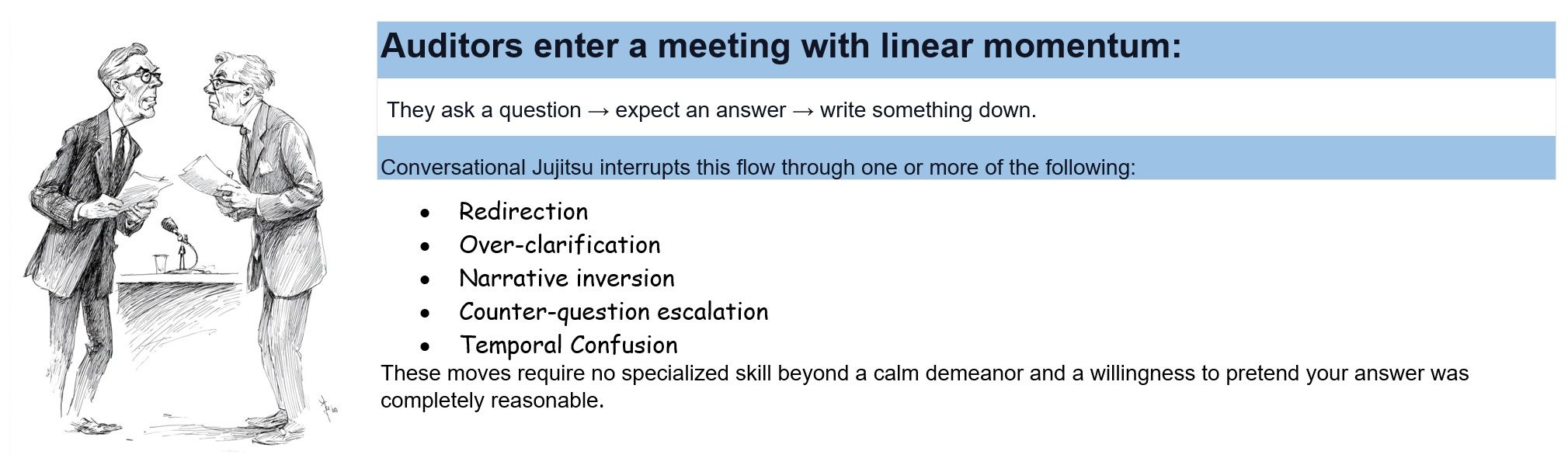
Auditors enter a meeting with linear momentum:
They ask a question → expect an answer → write something down.
Conversational Jujitsu interrupts this flow through one or more of the following:
- Redirection
- Over-clarification
- Narrative inversion
- Counter-question escalation
- Temporal confusion
These moves require no specialized skill beyond a calm demeanor and a willingness to pretend your answer was completely reasonable.
Move #1: The Clarification Cascade
Auditor: “Can you show evidence of approval for this transaction?”
You: “Absolutely. Before I answer… how do you define ‘approval’?”
This forces them to retreat into a forest of definitions they didn’t want to articulate. You can then ask:

- “Is that operational approval or existential approval?”
- “Should we consider explicit, implicit, or karmic authorization?”
- “Is timestamp drift relevant here?”
Eventually, they forget the original question and begin documenting your question instead.
Figure 8-1
A flow chart showing a question splitting into increasingly smaller questions until it becomes a mist.
Move #2: Temporal Displacement
Answer a present-day question using an answer about a future or past version of the process.

Auditor: “When do you reconcile this report?”
You: “Historically, we perform reconciliations proactively after the finalization of the upcoming cycle.”
They will try to parse that. They will fail.
If they press, add:
“The process is iterative across time.”
This sentence means nothing and yet feels profound.
Move #3: The Compliance Mirror
Reflect the question back at the auditor in a way that implies they are the one being evaluated.

Auditor: “Do you have controls around user access?” You: “Great question. How do you assess the maturity of access-control frameworks?”
- They will begin explaining their methodology.
- Take notes. Nod slowly.
They now believe they are at a conference.
Move #4: The Procedural Odyssey
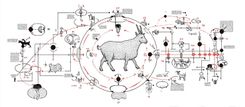
Give an answer so long, winding, and detailed that the auditor loses their will to continue.
Example:
Auditor: “How do you validate vendor data?”
You: “Well, after the preliminary cross-review, we perform a Stage 0 handshake.
That leads to a pre-authorization staging queue, where a legacy PICK subroutine —written in 1989 by someone who has since moved to a monastery —runs a checksum validation against a shadow table.
This, of course, triggers the reconciliation precursor…”
By slide 14, their soul will leave their body.
Move #5: The Reverse Evidence Request
A bold but effective maneuver.

Auditor: “Can you show evidence that this control executed properly?”
You: “Absolutely. Before I do, can you show evidence of the criteria you used to assess this control’s relevance?”
They will flip through their binder.
You have won.
Move #6: The Socratic Stall

Turn every question into a philosophical debate.
Auditor: “Who approves changes in production?”
You: “Ah, the timeless question of control versus autonomy. What is ‘approval,’ really?”
If they attempt to respond, interrupt with:
“And can approval exist independently of observation?”
This buys you at least 20 minutes.
Move #7: Weaponized Honesty
The rarest technique.
Auditor: “Why is there no documentation for this process?”
You: “Because we didn’t write any.”
The terrifying simplicity of this answer often causes auditors to rethink their entire approach.
They will rummage desperately for nuance. There is none.
Advanced Combination Moves
For ambitious practitioners:
Temporal Displacement + Mirror:
“When would you say the process should occur?”
Clarification Cascade + Odyssey:
“Before answering, let me walk you through our complete history of invoice management.”
Socratic Stall + Reverse Evidence Request:
“Can anyone truly own a control? And how do you measure the ownership of your measurement?”
This level of Jujitsu should only be used during external audits or when you didn’t have time to prepare.
Safety Considerations
While Conversational Jujitsu is powerful, it must never be used to evade compliance responsibilities.
However, it is perfectly acceptable to use it to:

- defend your sanity,
- slow down an overly enthusiastic auditor, or
avoid explaining why the 1980s PICK program still runs the general ledger.
Footnotes
Conversational Jujitsu is not recognized by the PCAOB, though it is widely practiced.
Time travel metaphors should only be used when auditors are caffeinated.
“Weaponized Honesty” has a maximum recommended dosage of one use per quarter.
Summary
Conversational Jujitsu is not about winning—auditors do not recognize victory.
It is about redirecting momentum, amplifying ambiguity, and allowing the audit meeting to resolve itself through entropy.
Used correctly, these techniques will leave auditors confused, oddly respectful, and slightly afraid to ask follow-up questions.
Next article
Rituals and offerings. Preparing for the annual audit
Next Step:
🗓️ Schedule a discovery call
Talk about issues and opportunities for your current system before you commit.


