




Making an Easy Decision for a Difficult Problem
Technology leaders at the helm of legacy enterprises face a dilemma that’s as familiar as it is uncomfortable: the systems that got you here are not the ones that will take you where you need to go next.
You’ve invested decades into custom-built infrastructure—core systems that have served the business well. But now, modernization pressures are mounting. Customers expect real-time everything. Your workforce is aging out. New hires want nothing to do with green screens and batch jobs. And yet, a full rip-and-replace sounds risky, disruptive, and possibly disastrous.
This is where many modernization efforts stall.
“What if the choice between staying and leaving isn’t binary”
What if hybrid isn’t a halfway measure, but a strategy in its own right?
The False Dichotomy: Modernize or Maintain
C-level leaders are often presented with a false choice:
- Option A: Maintain the legacy systems, continue patching, and hope the wheels don’t fall off.
- Option B: Undertake a high-stakes, high-cost digital transformation, ripping out core systems and rebuilding from scratch.
The cost of failure in either direction is huge.
On one side, you risk becoming obsolete, unable to integrate with new platforms or scale with customer expectations. On the other, you may spend millions and lose years chasing a transformation that never quite lands—alienating teams, fracturing operations, or worse, grinding the business to a halt.
This is why "Hybrid" deserves a third column in the executive playbook.
What Is a Hybrid Strategy, Really?
A hybrid strategy doesn’t mean hedging your bets or settling for less. It means intelligently blending legacy strengths with modern capabilities—on your terms, at your pace, with clear wins along the way.
It’s about:
- Keeping what works.
- Wrapping legacy logic in modern APIs.
- Migrating data in phases.
- Integrating cloud-native services gradually.
- Creating a roadmap that reflects business realities, not vendor fantasies.
In short, it’s not compromise—it’s control.
Why Hybrid Works: Five Executive-Level Reasons
1. It Reduces Risk Without Sacrificing Progress
Hybrid strategies allow for parallel progress: modern components can be developed and tested alongside legacy systems before they go live. This reduces the classic “big bang” risk and gives teams time to validate, adapt, and correct.
A customer portal can go live while the back-end system remains intact. A new reporting dashboard can tap into legacy databases without forcing a complete schema redesign. It’s transformation, without the trauma.
2. It Protects Institutional Knowledge
Legacy systems are rich in business rules, logic, and nuance. Too often, modernization wipes this slate clean—only to relearn the hard way what the old systems already “knew.”
Hybrid enables you to encapsulate and reuse existing logic while gradually translating it into modern frameworks. You don’t lose the wisdom of the system—or the people who built it.
3. It Enables Continuous Value Delivery
Rather than waiting 18–36 months for a new system to be ready, hybrid strategies support incremental improvements. Each release delivers tangible business value—whether it’s faster invoicing, automated workflows, or better analytics.
This keeps stakeholders engaged, reduces change fatigue, and builds momentum across departments.
4. It Aligns with Workforce Transition
Let’s be frank: many legacy developers are retiring. Their successors are cloud-native, JavaScript-savvy, and impatient with 80s-era development paradigms.
Hybrid strategies create a bridge between generations. Veteran developers maintain core systems while new teams build modern components—often working side by side, learning from each other. Over time, knowledge is transferred and ownership shifts smoothly.
5. It’s Budget-Friendly and Board-Approved
Modernization doesn’t have to be a $100M moonshot.
Hybrid allows for measured investment, with smaller, ROI-driven milestones that demonstrate value early and often. Boards like seeing progress that doesn’t break the bank. CFOs like seeing roadmaps with options, not ultimatums.
In a climate of capital scrutiny and digital urgency, hybrid wins on both counts.
Hybrid in Action: A Real-World Scenario
Let’s take the case of a regional insurance company running a claims system built in PICK BASIC—stable, battle-tested, but stuck in the 1990s.
The CIO, caught between a rock (retiring developers) and a hard place (demand for digital claims submission), took a hybrid approach:
- Exposed core functions via RESTful APIs using middleware.
- Introduced a modern React-based front end for customers and agents.
- Phased out green-screen terminals, starting with the least-used departments.
- Moved data gradually to MongoDB, while maintaining backward compatibility.
- Replaced modules one by one, prioritizing areas with the highest support costs.
Twelve months in, they had improved NPS scores, cut ticket resolution time in half, and avoided system downtime. Not because they jumped off a cliff—but because they crossed the bridge they built.
How to Pitch Hybrid to the Board
Your board doesn’t want jargon. They want clarity, confidence, and cost control.
Here’s how to make the case:
- “We’re not replacing everything. We’re modernizing what matters.”
- “We’ll deliver business value in 90-day increments—not 3-year promises.”
- “We retain operational stability while moving toward future agility.”
- “The total cost is predictable, and early results fund the next steps.”
The beauty of hybrid is that it tells a pragmatic story. It’s not a bet. It’s a plan.
What Hybrid Is Not
Let’s be clear—hybrid is not:
- A license to do nothing.
- A reason to over-engineer wrappers and band-aids.
- A substitute for vision.
Hybrid is a deliberate, architectural approach to sequencing your modernization in a way that aligns with the business—not an excuse to avoid it.
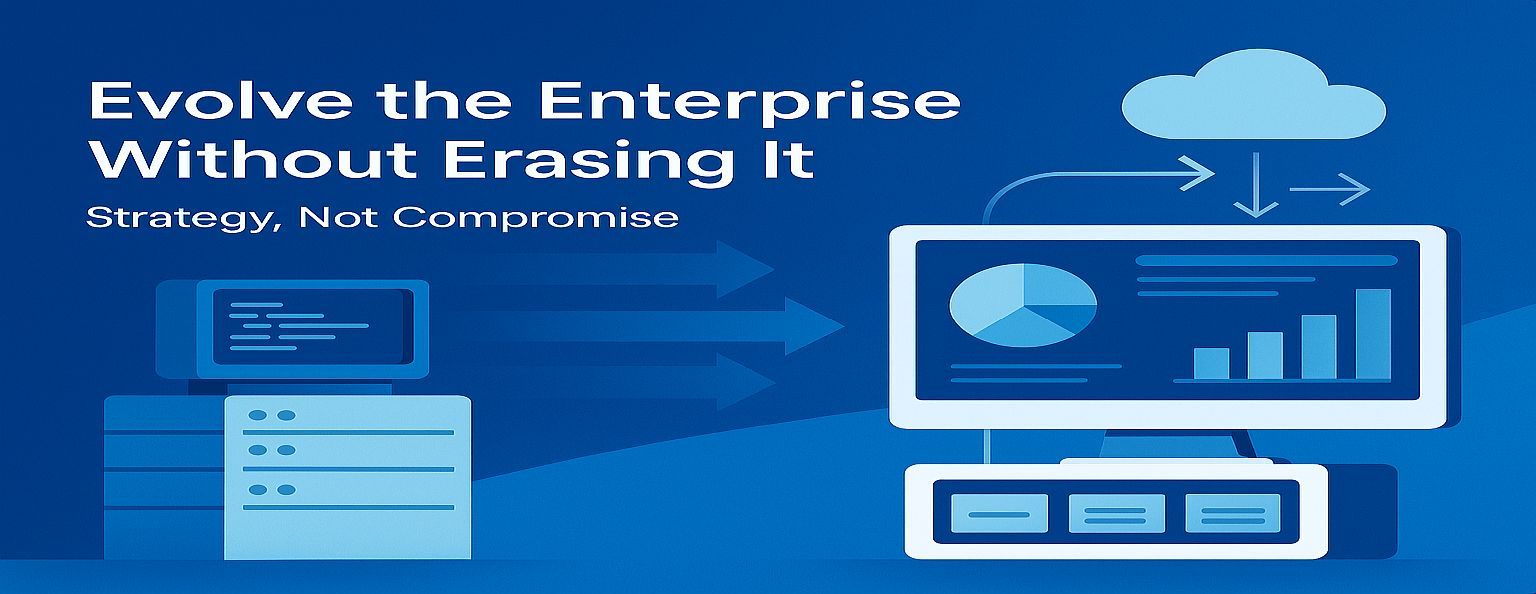
Done right, hybrid strategies evolve the enterprise without erasing it.
Getting Started: The Three-Part Executive Checklist
If you're considering a hybrid approach, start here:
1. Assess What Should Stay and What Must Change
- Which systems are truly core?
- Where are the friction points for users?
- Where does your legacy add value, and where is it holding you back?
2. Identify Low-Risk, High-Impact Starting Points
- Can customer access be modernized via a portal?
- Can reporting be offloaded to a more agile environment?
- Are there manual processes ripe for automation?
Start with wins that demonstrate progress and build stakeholder trust.
3. Build the Right Team for a Dual-Skill World
- Pair legacy veterans with modern developers.
- Document business rules as you go.
- Ensure architecture supports co-existence—not just end-state replacement.
This isn’t about just building new—it’s about bridging old and new with intent.
Final Word: Give Yourself Permission to Be Strategic
Hybrid is not a consolation prize. It is not an apology. And it is absolutely not indecision.
It is a deliberate, strategic choice—one that prioritizes continuity and progress, respects institutional wisdom, and puts control back in the hands of business leaders.
The easiest decision you can make about modernization isn’t when to start or how much to spend.
It’s to stop pretending you must choose between legacy and innovation.
You can have both.
Just don’t call it a compromise.
Try It Before You Bet the Business:
A 90-Day Hybrid Pilot with BinaryStar
For executives who like to test before they commit, BinaryStar offers a 90-day hybrid pilot that delivers real business results without disrupting core operations.
This isn’t a proof-of-concept in a lab—it’s a working solution inside your enterprise. We identify a high-impact, low-risk opportunity—often a customer-facing portal, reporting module, or middleware layer—and stand it up alongside your existing system. Your team gets to see hybrid in action, and your stakeholders get to feel the difference.
At the end of 90 days, you’re not just “convinced”—you’re in motion.
Next Step:
🗓️ Schedule a discovery call
Talk about issues and opportunities for your current system before you commit.


