


The Dilemma
For many enterprises, the systems that still run the business were written before the people now running it were born. The code works—remarkably well, in fact. Orders are processed, invoices flow, and the machinery of commerce hums along inside a database that hasn’t changed in decades. But the world around it has. Markets now move at digital speed; customers expect integration, insight, and instant access. And that old legacy system—efficient, stubborn, opaque—has become both the backbone and the bottleneck.
The Philosopy
Boardrooms across industries are confronting the same dilemma: what’s the responsible path forward? Broadly, there are three: A. convert core legacy applications to a modern database such as MongoDB, B. take a hybrid approach, migrating only select core groups while maintaining the rest, or C. remain on legacy, but build APIs to expose its data to the outside world.
Each carries its own calculus of risk, reward, and realism.
A. Full Migration to Mongo: Rewriting the Future

Moving entirely from Legacy to Mongo is not just a technical shift—it’s a philosophical one. MongoDB represents the world of open data: JSON documents instead of rigid records, flexible schemas instead of fixed dictionaries. For an executive audience, what matters is not the syntax but the potential: visibility, agility, and talent renewal.
A full migration opens the door to integration with the vast modern ecosystem: analytics, automation, AI. Once data lives in Mongo, it can be visualized, mined, and enriched without the bespoke translation layers that make legacy systems so brittle. New teams—developers fluent in JavaScript and Python rather than Legacy —can join the conversation without needing to decode half a century of idiosyncrasies.
For large organizations, a successful migration resets the enterprise clock. Suddenly, the data that was once siloed becomes portable. The business gains the ability to experiment again: to model “what if” without rewriting everything.
But the road is long. Full migrations demand patience, precision, and a deep respect for the institutional logic embedded in those old programs. Every rule, exception, and calculation was written by someone for a reason. Unpacking that is both art and archaeology. Misjudge the scope, and timelines slip. Over-abstract the model, and you risk erasing valuable nuances.
Yet, when done deliberately—with strong governance and a clear vision—the result is an enterprise that can evolve on its own terms, not at the mercy of its limitations.
B. The Hybrid Approach: Evolving Without Erasing

The hybrid model is where many forward-looking companies find their footing. Here, leadership identifies specific areas where modernization brings the greatest strategic lift—say, CRM, inventory, or reporting—while leaving stable legacy systems intact.
This approach appeals to pragmatists. It reduces exposure, preserves operational continuity, and lets teams learn by doing. Instead of a massive rewrite, it’s an orchestrated series of transformations. One domain moves to Mongo; another stays where it is; the two talk through well-designed interfaces. The business keeps running while it modernizes.
Hybrid architectures also buy time for cultural adaptation. Teams can cross-train. Managers can develop new governance muscles. The enterprise learns to think in terms of services rather than monoliths—how to expose, consume, and reuse data.
Still, hybrids can become permanent half-measures if not managed with discipline. The longer two systems coexist, the more integration glue accumulates. Interfaces need monitoring; synchronization needs testing; data definitions can drift. Without a clear modernization roadmap, hybrid turns into “hanging bridge”—strong enough to cross, but never finished.
When executed intentionally, however, hybrid models offer the best of both worlds: the reliability of the legacy with the innovation velocity of the new. They create an internal laboratory for modernization—proof that change can succeed without chaos.
C. Staying on Legacy with an API: Breathing Modern Air Through Old Lungs
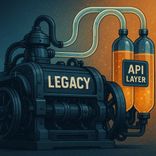
The third option, often framed as “if it isn’t broken, don’t fix it,” centers on building an API layer atop the existing legacy environment. Through these interfaces, customers, vendors, and partners can interact with the system as if it were modern—checking order status, submitting quotes, updating shipments—without the underlying code ever changing.
From the outside, this looks progressive. The enterprise becomes more connected, responsive, and accessible. For leadership, it’s a way to extend the lifespan of proven systems while exploring new frontiers. It’s the equivalent of adding oxygen tanks to an aging diver—they can go deeper, but the suit is still old.
The advantage is clear: minimal disruption. The business continues uninterrupted, and the cost is largely confined to integration rather than replacement. But the underlying constraints remain. The same data model, the same code fragility, the same dependency on the few who still speak Pick or Cobol.
APIs act as translators, not rejuvenators. Over time, the surface may look modern, but the structure beneath can become increasingly brittle. Talent scarcity grows. Regulatory and audit demands tighten. Eventually, even the most robust interface cannot conceal the aging core.
The Complications of Staying Put
Every year a legacy system remains untouched, the cost of inaction compounds invisibly. The problems are rarely immediate; they manifest in opportunity loss—projects deferred, integrations delayed, insights missed.
- Talent attrition: The people who understand the old code retire or move on. Recruiting replacements is nearly impossible.
- Compliance exposure: Auditors struggle to verify processes embedded in opaque code. Each workaround increases complexity and risk.
- Innovation drag: Modern partners and vendors expect REST APIs, real-time data, and transparency. Legacy systems slow every new initiative.
- Operational fragility: Documentation gaps mean even small changes carry unknown side effects. Fear of “breaking it” becomes policy.
These complications don’t make legacy systems villains—they’ve earned their keep. But loyalty to them must be weighed against the cost of paralysis.
The Opportunities After Migration
Once the core logic and data are liberated into Mongo and its ecosystem, the enterprise inherits a new horizon of possibilities:
- Data unification: Information from different business units can finally speak a common language.
- Analytics and AI: Machine learning tools can be applied directly to operational data, revealing inefficiencies or predicting demand.
- Rapid innovation: Prototyping a new service becomes a matter of weeks, not quarters.
- Integration agility: Partner ecosystems—suppliers, regulators, customers—can interact through secure, standardized APIs.
- Cultural renewal: Modern tools attract modern talent. Younger developers can contribute without decoding hieroglyphics.
Migration doesn’t just improve performance; it reframes the company’s relationship with technology. The system evolves from being a fixed cost to being a creative platform.
The Philosophy of “Vibe Coding”: Translating Intention, Not Just Code

Anyone who has ever maintained legacy applications knows that much of the brilliance lives between the lines. The logic often feels more like folklore than engineering—decisions made in the rhythm of the business, not the syntax of a language. A credit check routine might embody the founder’s intuition about customer reliability. A pricing loop might reflect the seasonal wisdom of a sales manager from 1987. None of it is commented, yet all of it works.
This is what modern engineers have begun calling “vibe coding.” It’s not about what the program says; it’s about what it means. Translating that into Mongo and Node is not a matter of one-to-one syntax conversion. It’s an act of interpretation—of empathy, even. The question shifts from “how do we rewrite this?” to “what truth was this trying to express?”
That philosophical shift matters deeply. A literal translation preserves the past; a vibe-based migration preserves the intent. It allows modernization teams to design systems that honor the original insights while aligning them with current needs—automating, validating, and scaling those once-manual instincts.
In this way, migration becomes less about replacement and more about continuity of understanding. The goal is not to replicate every keystroke of the legacy, but to carry forward its intelligence in a form that can keep learning.
The Tools and What They Offer Leadership

For the board and the C-suite, the alphabet soup of modernization tools—containers, pipelines, frameworks, and clouds—matters only in what they enable. These technologies are not ends in themselves; they are instruments of visibility, control, and velocity. Executives don’t need to master Kubernetes or CI/CD—they need assurance that decisions are informed by real-time data, that systems are resilient under change, and that innovation moves faster without breaking what already works.
Modernization succeeds when technology becomes transparent, performance measurable, and strategy executable—when leaders can see, steer, and scale their enterprise with confidence.
- Governance dashboards show executives what’s running where, turning opaque systems into transparent assets.
- Rule-based abstraction layer reduces dependency on tribal knowledge, ensuring repeatable, auditable processes.
- Integration platforms make cross-system collaboration practical, not painful.
- Cloud management tools provide elasticity—resources that scale with demand, not with budget cycles.
These are not toys for technologists; they are instruments of strategic governance. They give leadership the same clarity over digital operations that they already have over finance and logistics.
The Decision Before the Decision
At its core, modernization isn’t about code—it’s about risk tolerance. It reveals how much change a company is willing to embrace to shape its own future.
The real question isn’t technical at all:
Does leadership see modernization as a threat to stability or as an investment in resilience and growth?

A full migration signals conviction—a willingness to invest in long-term freedom.
A hybrid strategy signals pragmatism—a careful balance of risk and renewal.
An API-only approach signals caution—a hope to stay relevant without disturbing the foundation.
Each is valid, but each carries an implicit statement about the organization’s appetite for change.
Conclusion
Executives and board members need not become technologists to make the right call. They need only to see the decision not as a technical upgrade, but as an act of stewardship. The legacy system once embodied the company’s genius. The task now is to preserve that genius while freeing it from the walls that once protected it.
Because in the long arc of enterprise life, the only true legacy worth keeping is the ability to adapt.
More: Hybrid is not a compromise
Next Step:
🗓️ Schedule a discovery call
Talk about issues and opportunities for your current system before you commit.